
Deciphering Data Architectures Is Now Available in Multiple Languages
Since the release of my book Deciphering Data Architectures: Choosing Between a Modern Data Warehouse, Data Fabric, Data Lakehouse, and Data Mesh, I’ve been fortunate to hear from readers around the world. One question I’ve received frequently is whether the book is available in languages other than English.
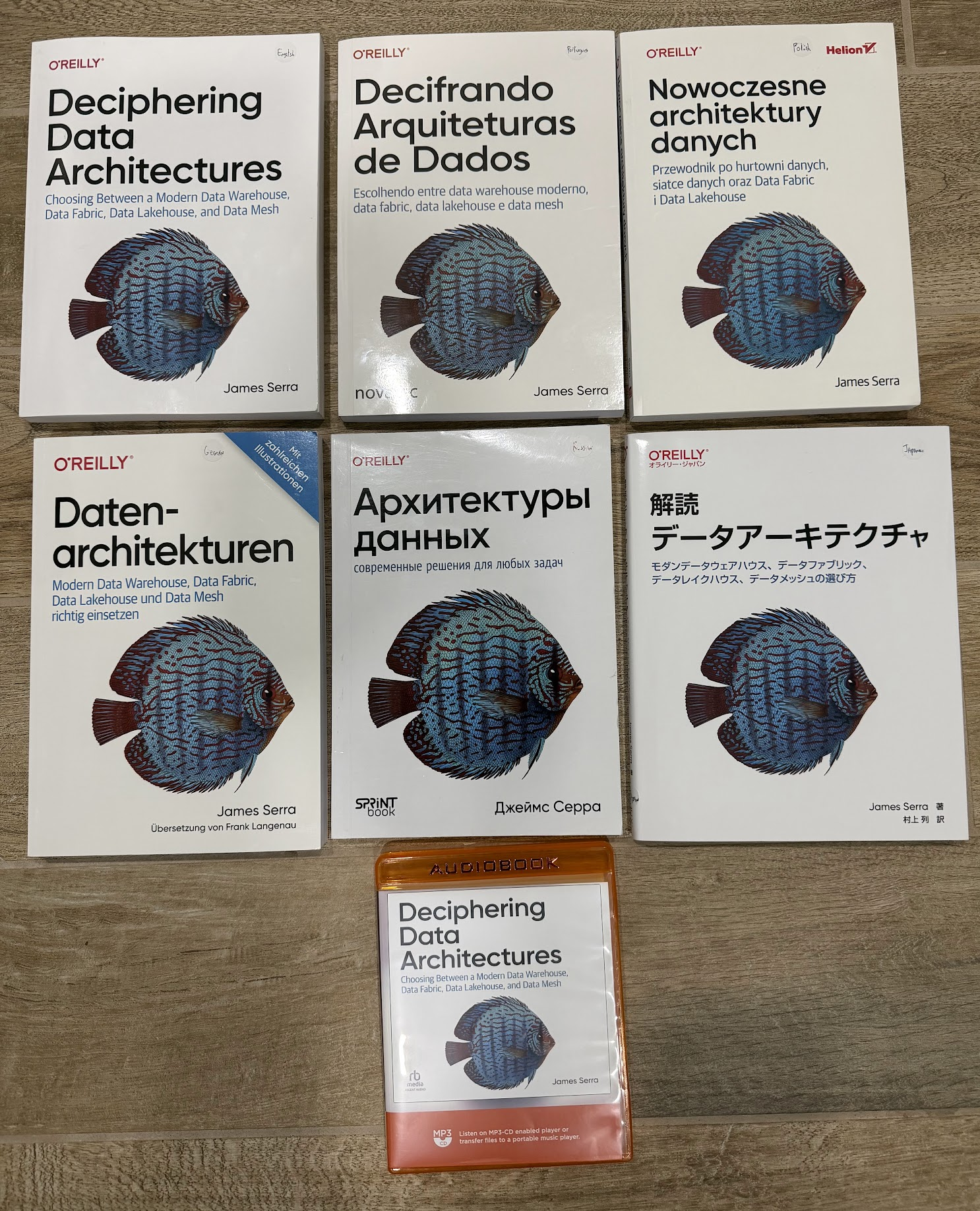
I’m happy to share that the book is now available in several translated printed editions, making it accessible to a much broader global audience.
Current printed editions include:
There are also machine-translated French and Italian editions available through the O’Reilly learning platform. These require an O’Reilly subscription and are available for online reading only.
In addition, an English audiobook is now available.
And there is more to come. A Chinese edition is due next month.
For readers in India, there is also a low-cost reprint edition available locally.
Why I Wrote the Book
Data fabric, data lakehouse, and data mesh have recently emerged as viable alternatives to the modern data warehouse. Each of these architectures offers real benefits, but they are also surrounded by a lot of hyperbole, confusion, and conflicting opinions.
That was one of the main reasons I wrote this book.
My goal was to provide a practical, vendor-neutral guide that helps data professionals understand the strengths, weaknesses, trade-offs, and ideal use cases for each architecture. Rather than promoting one architecture as the answer to every problem, the book helps readers understand when to use a modern data warehouse, data fabric, data lakehouse, data mesh, or some combination of these approaches.
What the Book Covers
In Deciphering Data Architectures, I examine common data architecture concepts, including how data warehouses have evolved to work with data lake capabilities. The book also explains what data lakehouses can help you achieve, how to separate data mesh hype from reality, and how to determine the most appropriate architecture for your specific needs.
With this book, you will:
- Gain a working understanding of several data architectures
- Learn the strengths and weaknesses of each approach
- Distinguish data architecture theory from reality
- Pick the best architecture for your use case
- Understand the differences between data warehouses and data lakes
- Learn common data architecture concepts to help you build better solutions
- Explore the historical evolution and characteristics of data architectures
- Learn the essentials of running an architecture design session, organizing teams, and improving project success
A Timeless, Product-Neutral Resource
One of the things I’m most proud of is that the book is free from product-specific discussions. While tools and technologies change quickly, the underlying architectural principles tend to last much longer.
That makes the book useful whether you are a data architect, data engineer, analytics leader, consultant, or technology executive trying to make sense of today’s increasingly crowded data architecture landscape.
The fact that the book is now available in so many languages is very meaningful to me. Data architecture challenges are global, and I’m excited that more readers around the world can now access the book in their preferred language.
If you have colleagues, customers, or friends who would prefer reading in Portuguese, Polish, German, Russian, Japanese, French, Italian, or soon Chinese, please feel free to share the appropriate edition with them.
Thanks to everyone who has read, reviewed, recommended, or shared the book. I truly appreciate the support.